
Strolling Nepal — From Kathmandu to Bhaktapur
The locals made it all worthwhile.

Kathmandu: “The Wooden City”
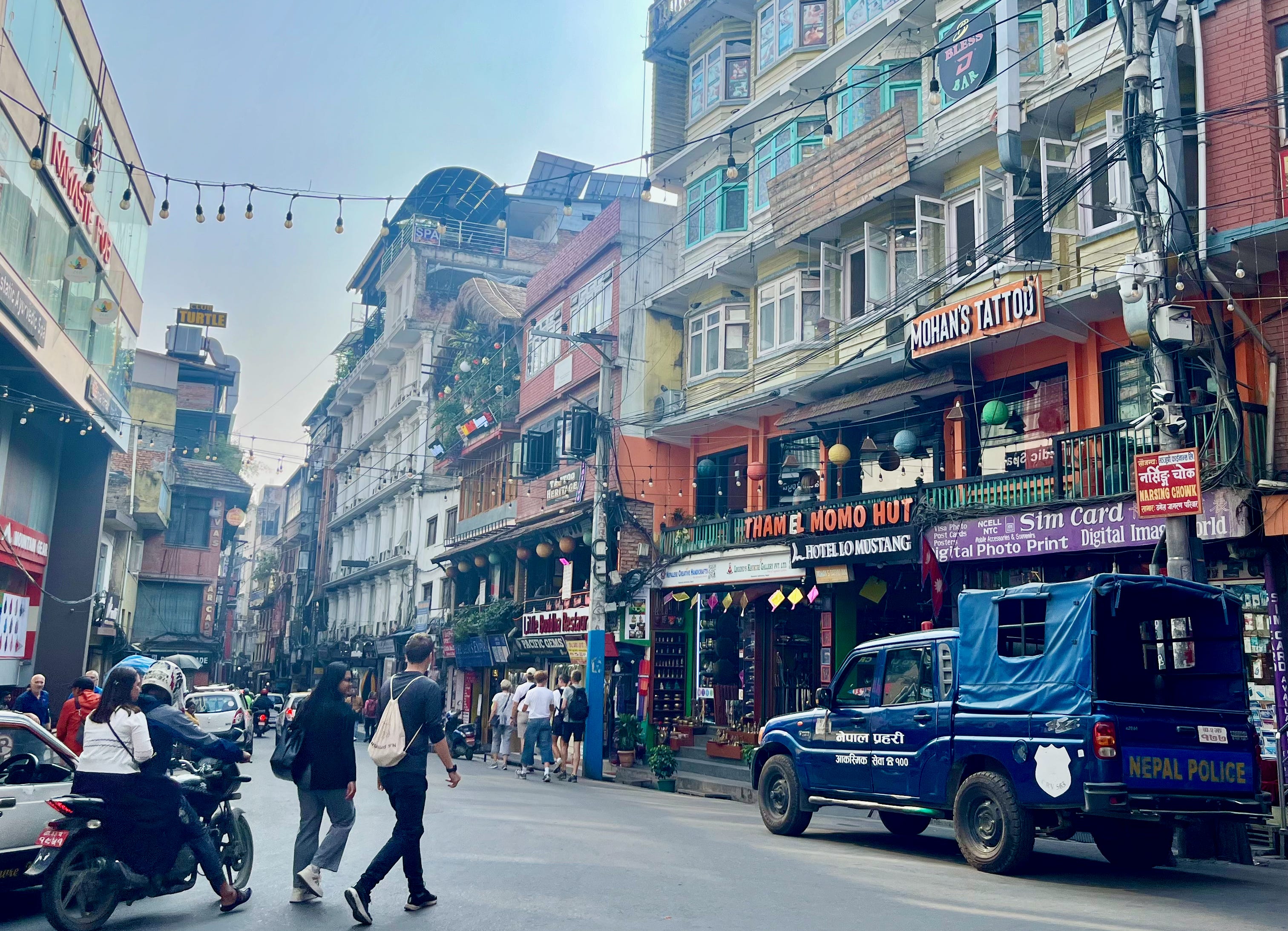
On my first day in Kathmandu, Nepal, a stranger approached me on the street.
“Hi, I’m an art student learning English. Would you mind if I showed you around? You don’t have to pay me, I just want to practice. My name’s Lovely.”
Normally, I would’ve said no, but Lovely, in his pink-collared shirt, had a kind face with a button nose and round glasses that framed his wide eyes.
“Sure.” I trusted him.
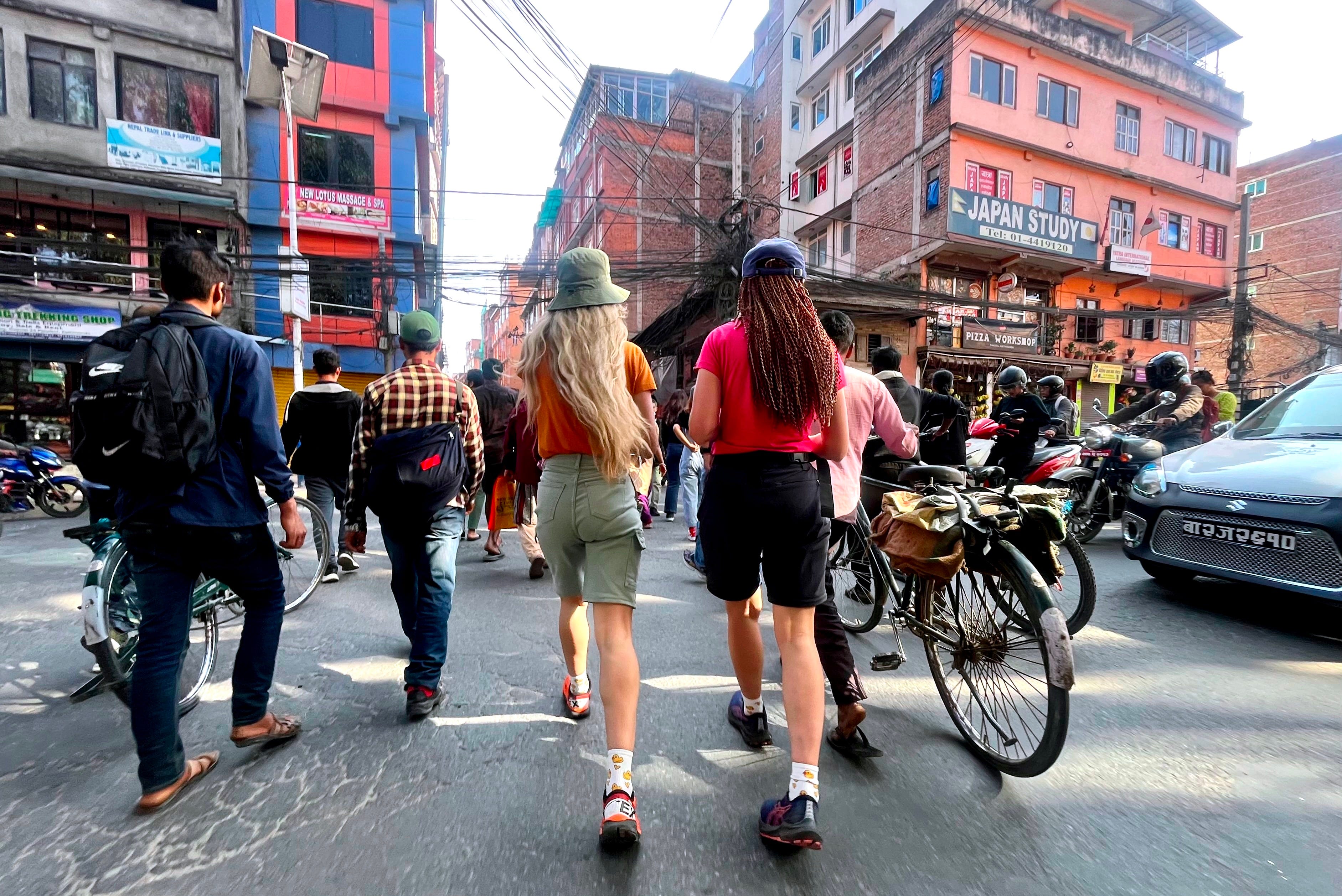
As we started walking through the streets, the air was thick with the smell of gasoline. Honking horns and the chatter of vendors added to the hum, but Lovely’s presence was knowing and confident. He knew the city’s hidden corners.
We passed narrow alleys, the yellow, blue, white, red, and green prayer flags fluttering above us. He pointed out shrines and small temples tucked away in quiet courtyards.
“Kathmandu is called the ‘Wooden City.’” Explained Lovely, “Since a king built one of its first temples from the wood of a single tree.”
I would’ve ventured alone through Kathmandu’s winding streets with nothing but an offline map, but having a local by my side proved to be infinitely better.
The shuttered windows on old apartment buildings we passed by reminded me of Bourbon Street in New Orleans, but with more motorcycles weaving in chaotic, unbroken streams. Even in the narrowest alleyways we went down to avoid the cyclists, a motorcycle would inevitably appear, taking a detour to avoid traffic. Lovely instructed me the only way to cross a street was to walk confidently and wave a “magic hand.” He demonstrated, holding his hand up to stop traffic.
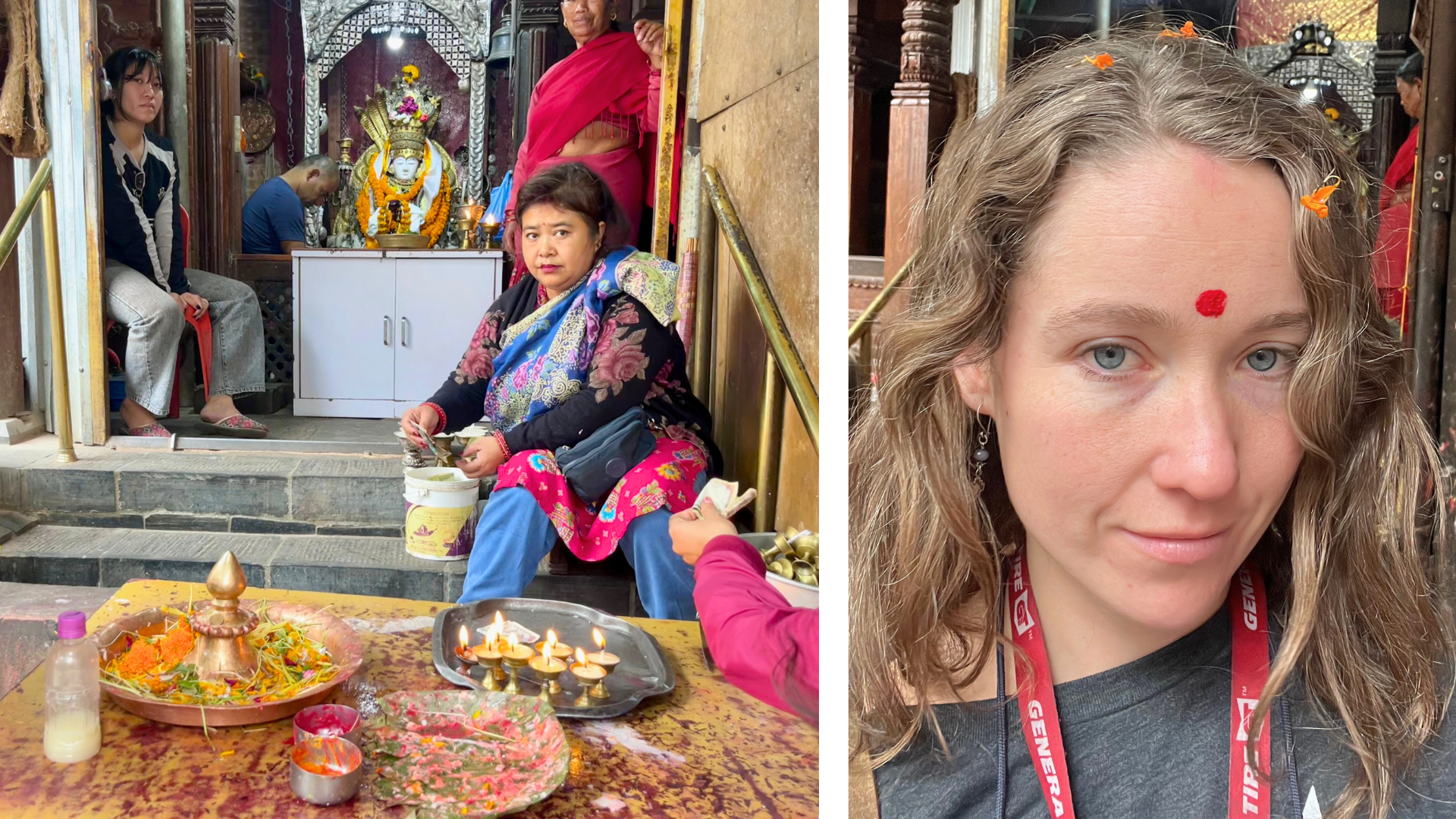
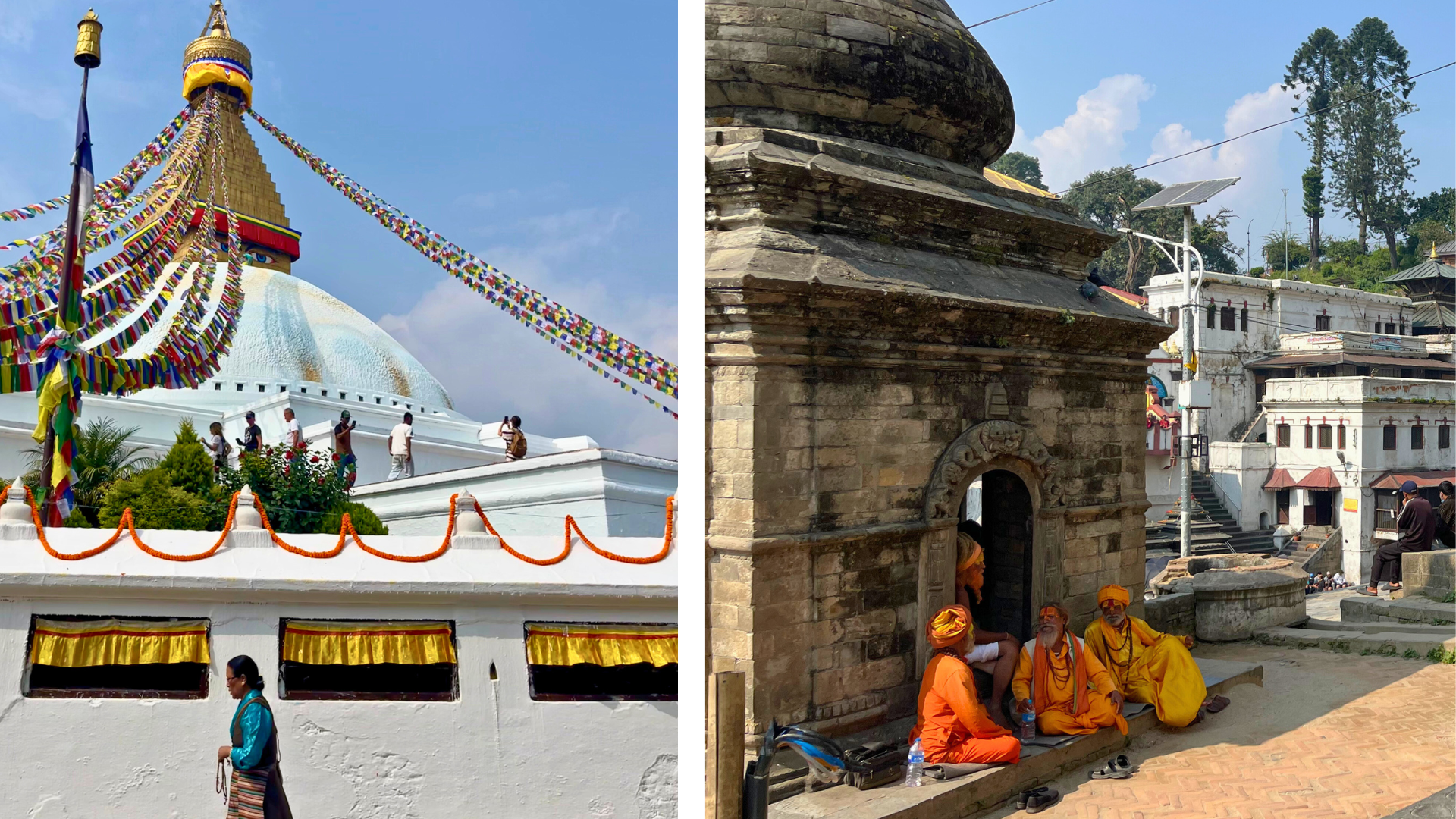
We passed Kathmandu’s best stupas (dome-shaped Buddhist shrines surrounded by paths for meditative walking), joining street-side rituals. We paid a couple rupees for blessings: tika dots on our foreheads and flower petals in our hair, and later sat in silent solidarity at one of the daily public cremations on the banks of the Bagmati River.
After a coffee, which I foolishly invited Lovely to join, since he informed me that, culturally, Nepali people drink tea, he took me to his art school, Enlightenment, where we were greeted by his teacher, a “master” artist.
If you visit Nepal, you will undoubtedly see Thanka artwork for sale at various stores. The art depicts Buddhist philosophy and deities. Some common images are mandalas and the Buddha’s eyes. They’re also often sold alongside paintings of scenes of backpackers, porters, and oxen in the Himalayas.
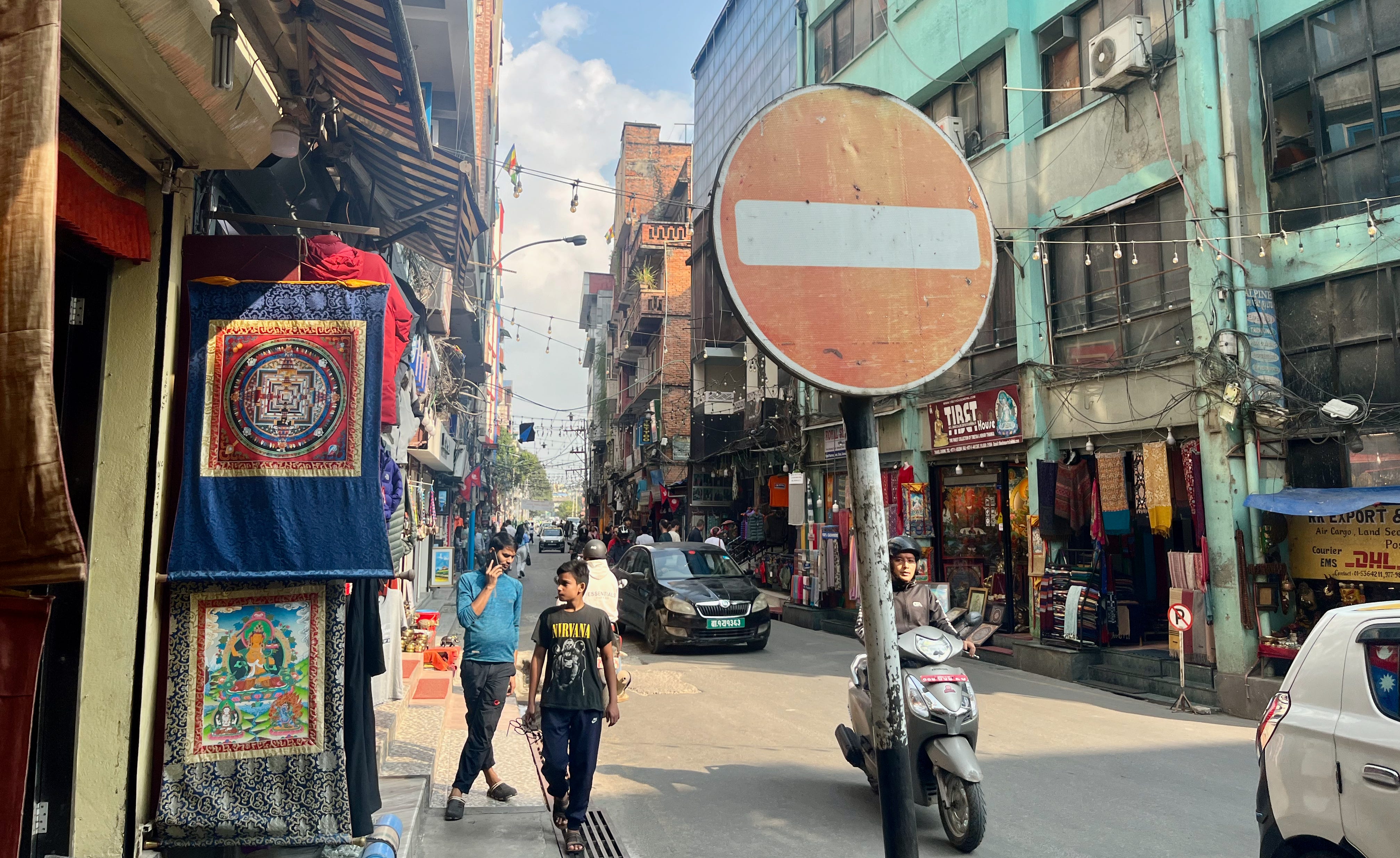
Following a stranger who approaches you on the street to buy art isn’t for everyone, but on that day, I was feeling particularly open and had planned to purchase art anyway, so I was up for it.
Some tourists, who feel like they’re constantly being sold to, might call Lovely’s approach an “operation,” but to me, it was a genuine way of connecting with a potential buyer. When he first spoke to me, he didn't mention selling art, he simply wanted to show me around and practice his English. Nepal, known for its warmth and hospitality, is generally considered a safe destination, with theft and scams being rare. Vendors may inflate prices, but it's often more about perception; many assume foreigners are wealthy. To avoid being taken advantage of, it’s important to have a budget and a sense of what things should cost. Don’t be afraid to negotiate.
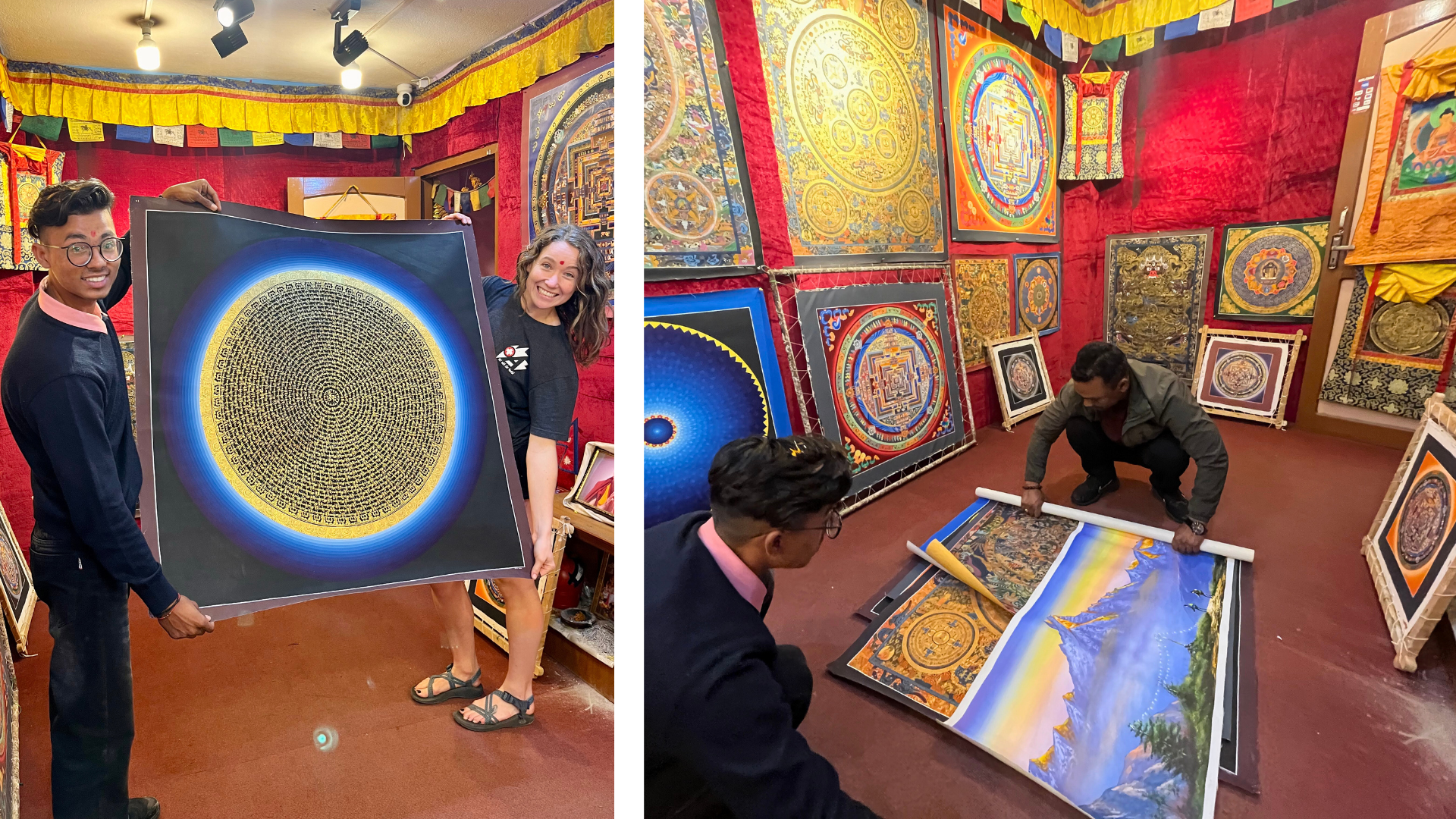
Enlightenment Art School is home to around 45 students, all dedicated to painting Thanka art. Some of the most intricate pieces can take up to nine months to complete.
Thanka paintings, made on smooth cotton canvas, depict Buddhist stories, events, philosophical teachings, and deities. They are important in Buddhist rituals, used as offerings during puja (an annual ritual celebrating one's essence and cleansing and empowering the soul) and as tools for meditation. Thanka painting began in the 11th century A.D., when Buddhists started to portray their deities. The art form spread to Tibet from Nepal after Princess Bhrikuti of Nepal married Songtsen Gampo, the King of Tibet. From the 15th century onward, stylistic changes began to appear in Thanka paintings, influenced by regional developments.
(If you’re interested in purchasing Thanka art, email me at codicoghlan@gmail.com!)
The biggest perk of purchasing art here was the free shipping and the ability to pay with a card. However, the initial prices for the works the master showed me were breathtakingly high, totaling around $7,000, which was far beyond my budget (maybe someone else could afford it). But when I insisted on my budget of about $1,000, the master graciously lowered the prices and ensured I received five pieces. I paid, wrote down my shipping address, and within five days, my mom confirmed that the paintings arrived in good condition.
When asked if he was happy to have sold his art, Lovely beamed and said, "My art displayed in the United States? It’s a dream come true."
Some Culture
Getting hungry, I asked Lovely if he’d had breakfast.
“Breakfast doesn’t exist in Nepalese culture; instead, the Nepalese people typically eat four meals a day, whenever they want, and drink tea, traditionally black and milk, instead of coffee.”
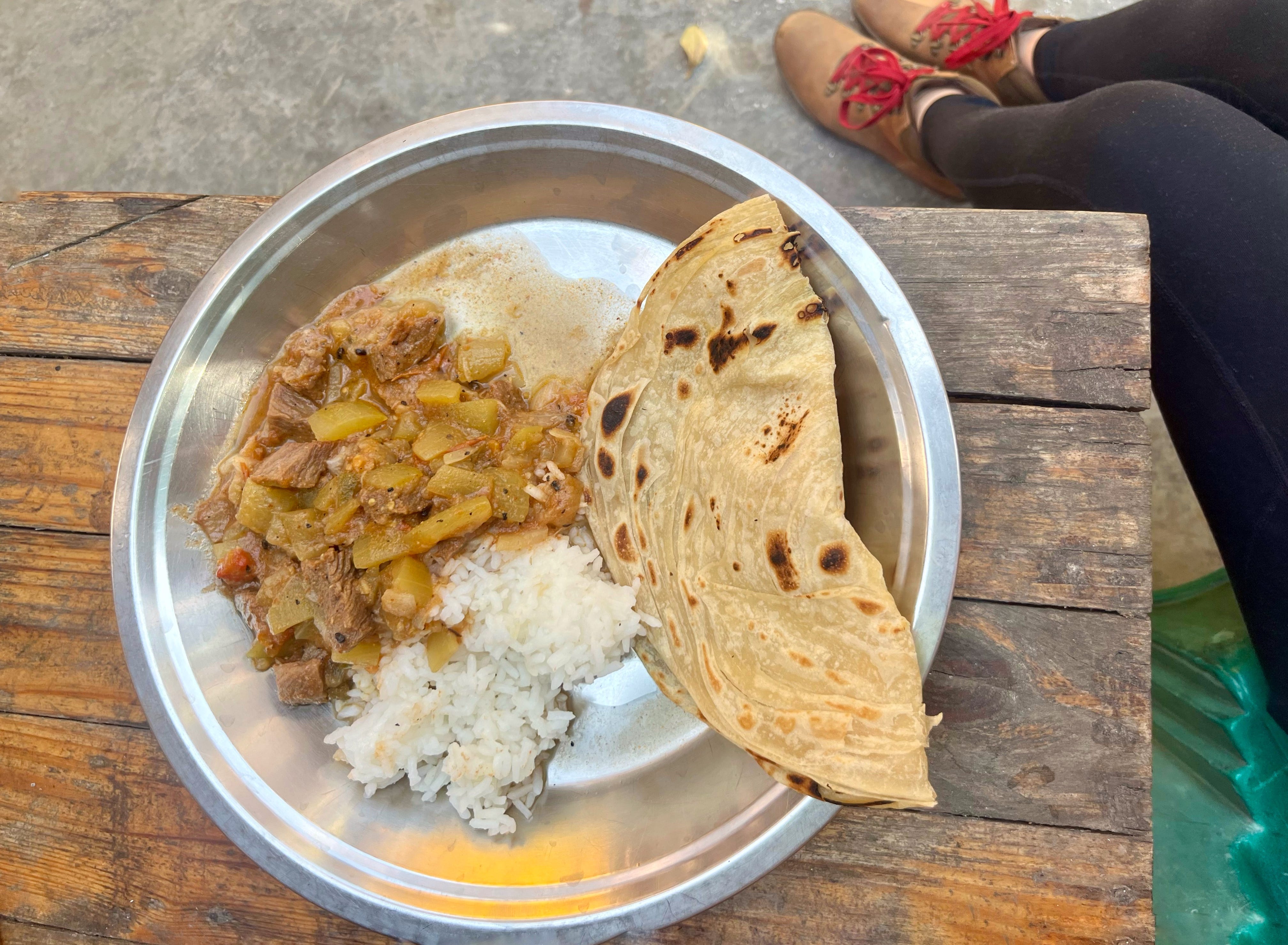
The Nepalese people also traditionally eat with their hands, scooping from the outside of the plate, where the food’s cooler, towards the inside, pushing the food up into their mouths with their thumb.
We stopped at a hole-in-the-wall for momo, which are dumplings typically served with a flavorful tomato-based sauce, and tea.
During lunch, Lovely brought up that, according to the Nepalese calendar, the year is 2081. It follows the same 12 months as the Western calendar, but the year begins in March. Additionally, the work week starts on Sunday, with Friday and Saturday designated as the weekend.
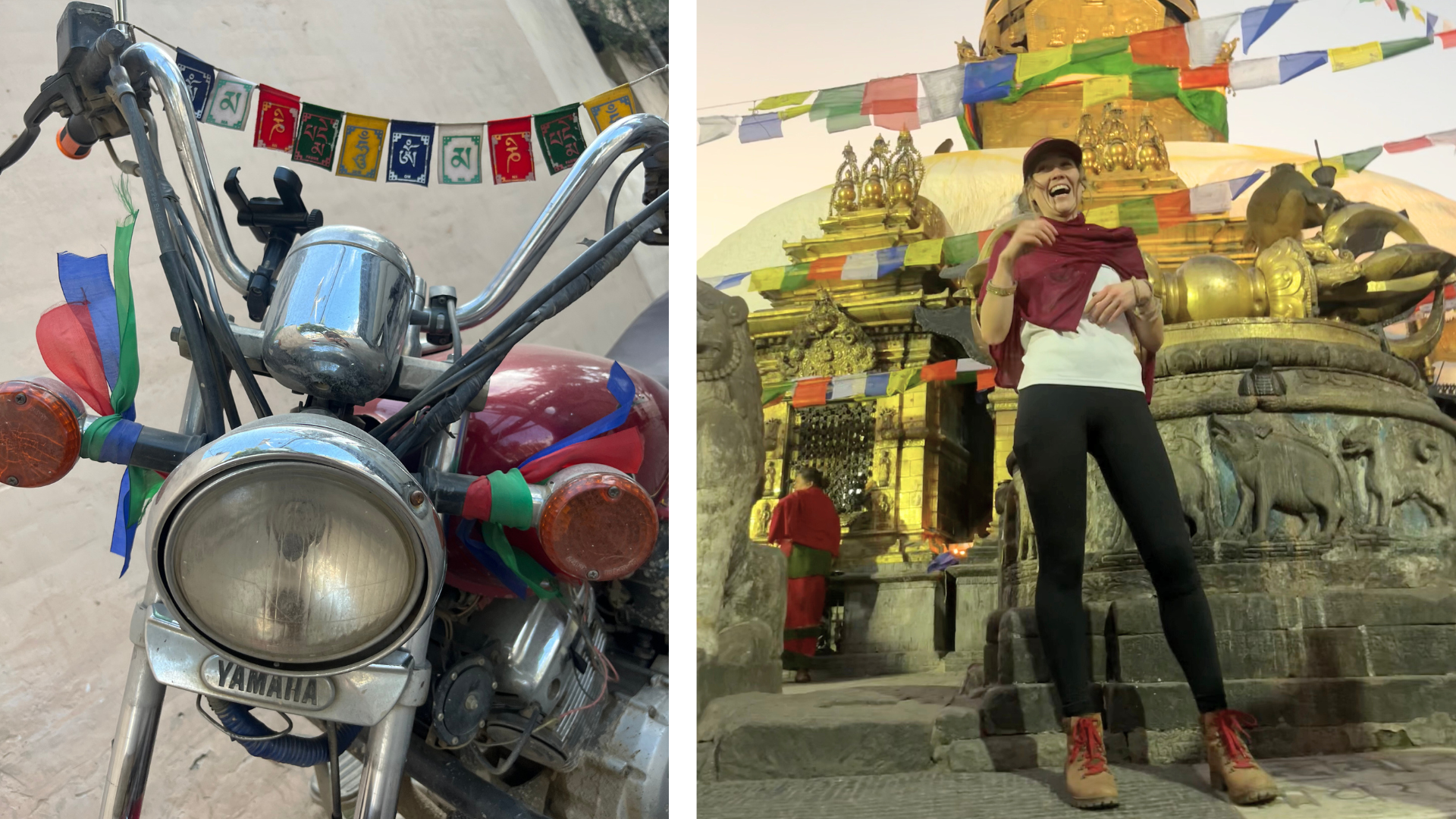
Prayer flags are everywhere in the streets of Kathmandu, and Lovely pointed out that written on each is a mantra: Om Mani Padme Hum: a chant from Tibet wishing good luck, happiness, inner peace, and a relaxed mind.
“Nepal stands for never ending peace and love. At least, that’s what it means to me,” Lovely grinned.
Boudhanath Stupa
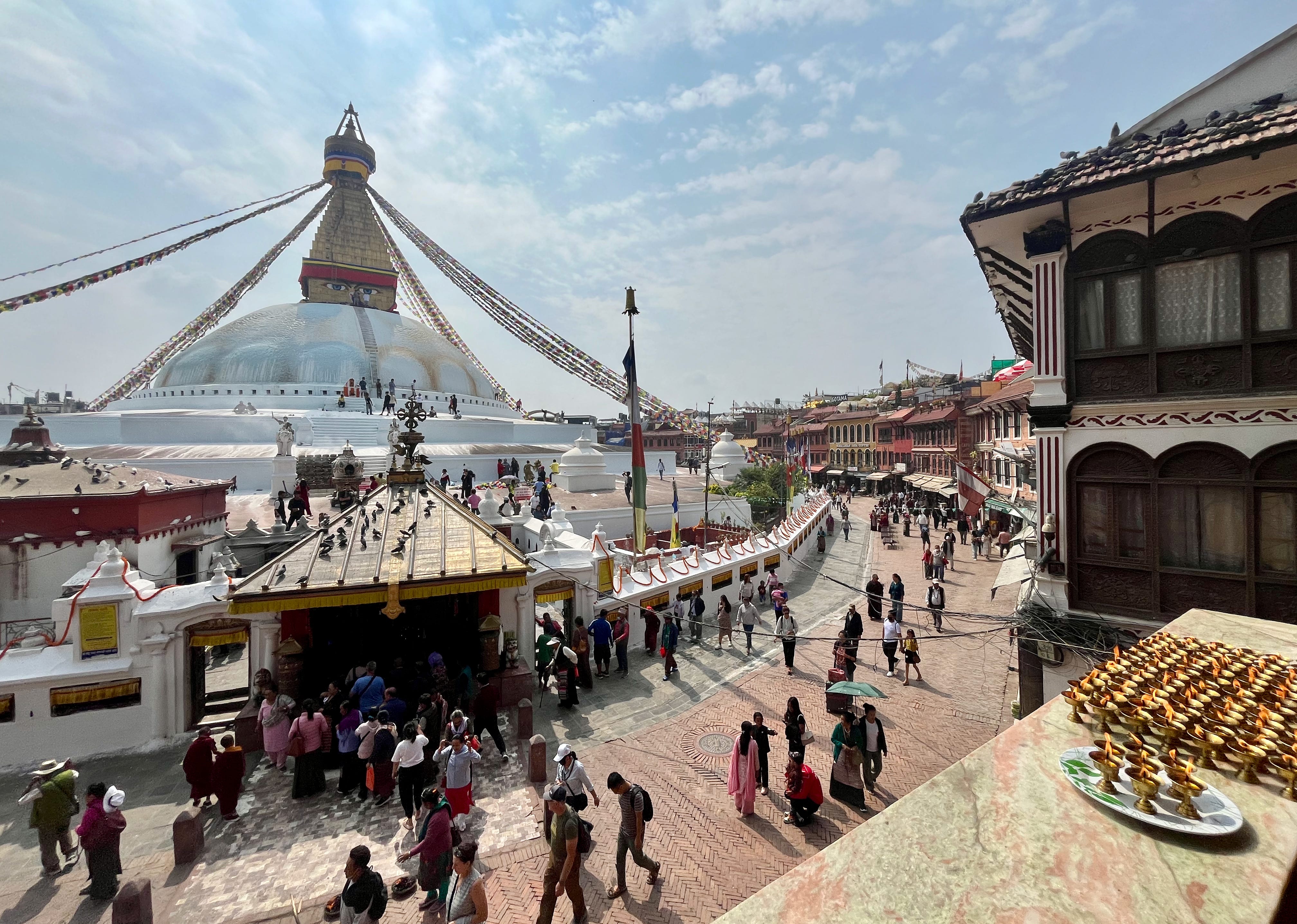
After lunch we set off to explore more, starting with Boudhanath Stupa, a 43-meter tall structure with a 7,631-square-meter base that spreads out like petals. It’s one of the most iconic sites in the city.
Lovely flashed his “magic hand” once again to cross the street, which is always bustling with traffic.
Every day, the masses circle the stupa, venerating its sacred presence and seeking blessings from above. Four blue eyes gaze outward in all directions from a copper harmika, just beneath the golden pyramid-shaped top. It’s located 7.5 miles east of Kathmandu Durbar Square.
“Do you meditate?” I asked Lovely.
“Yes, daily.”
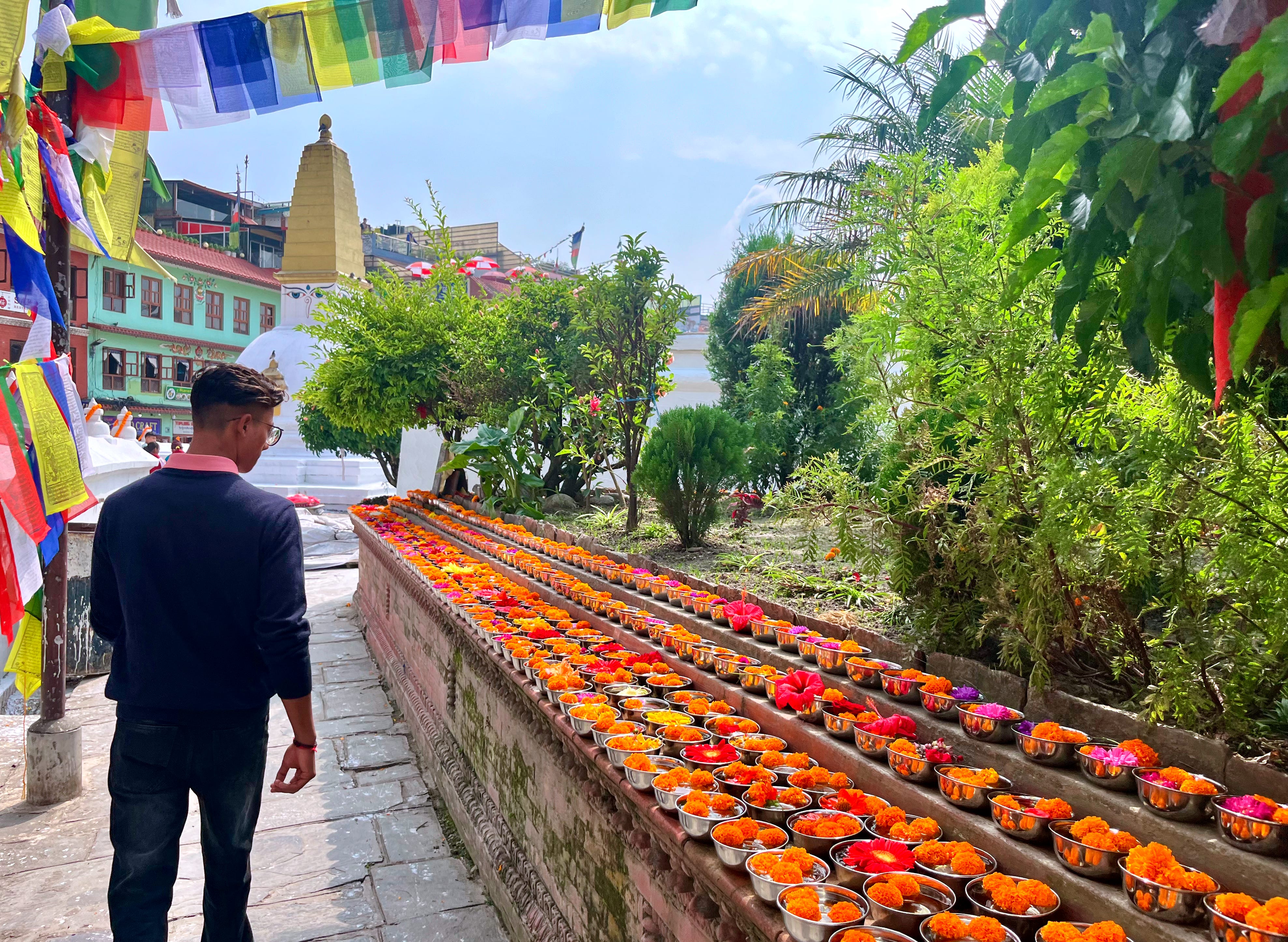
We wandered around the sacred Nepali stupa as tea-light candles flickered along the tops of ancient stone walls, while rows of orange and magenta flowers stretched neatly through the gardens.
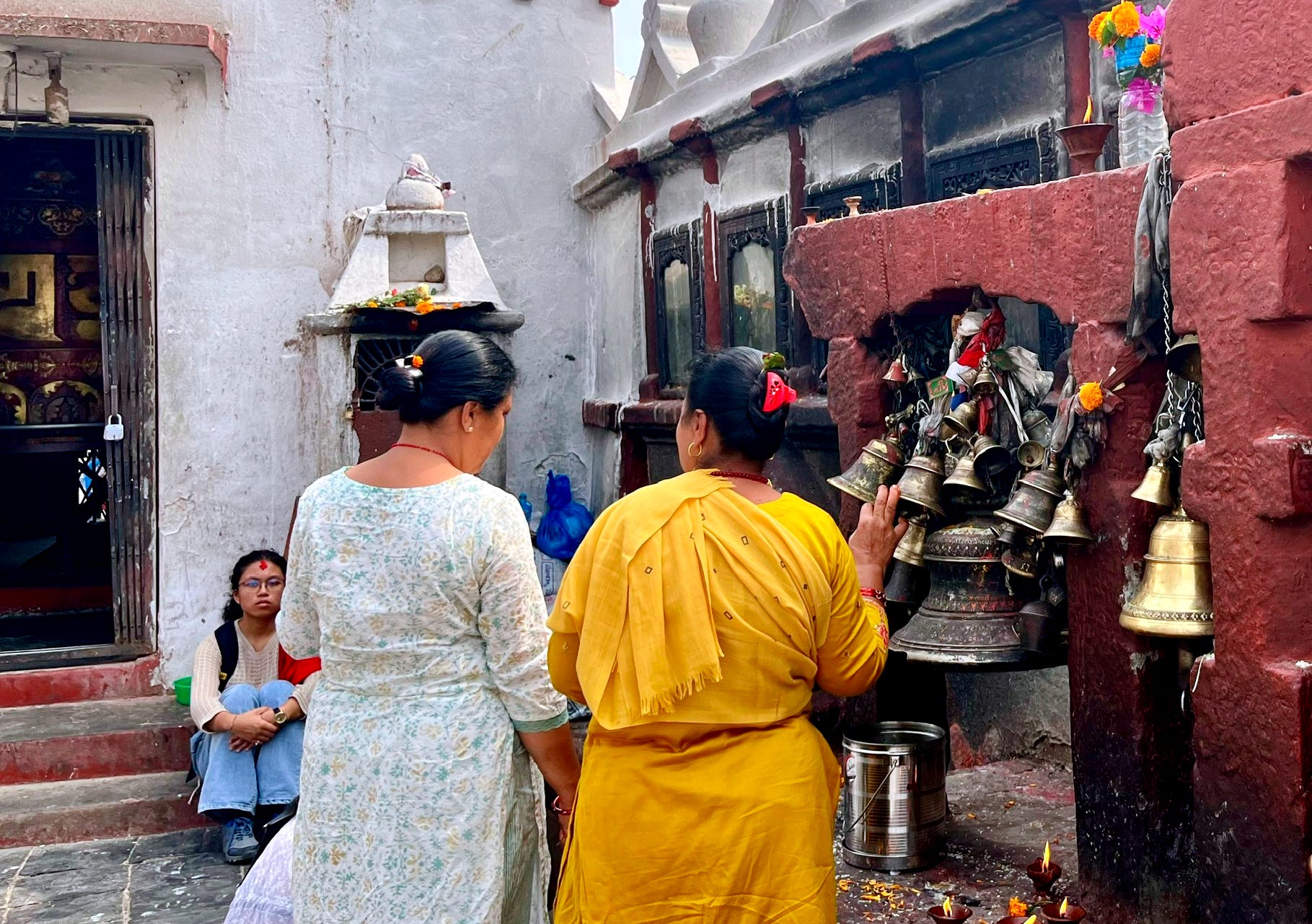
Many people, mostly women, had received blessings, marked by red “tika” dots of good luck on their foreheads. Spirituality was as present as sap in trees, oozing and congealing here in much the same way.
We passed what appeared to be a monastery with some monks and others mediating.
Pashupatinath Temple
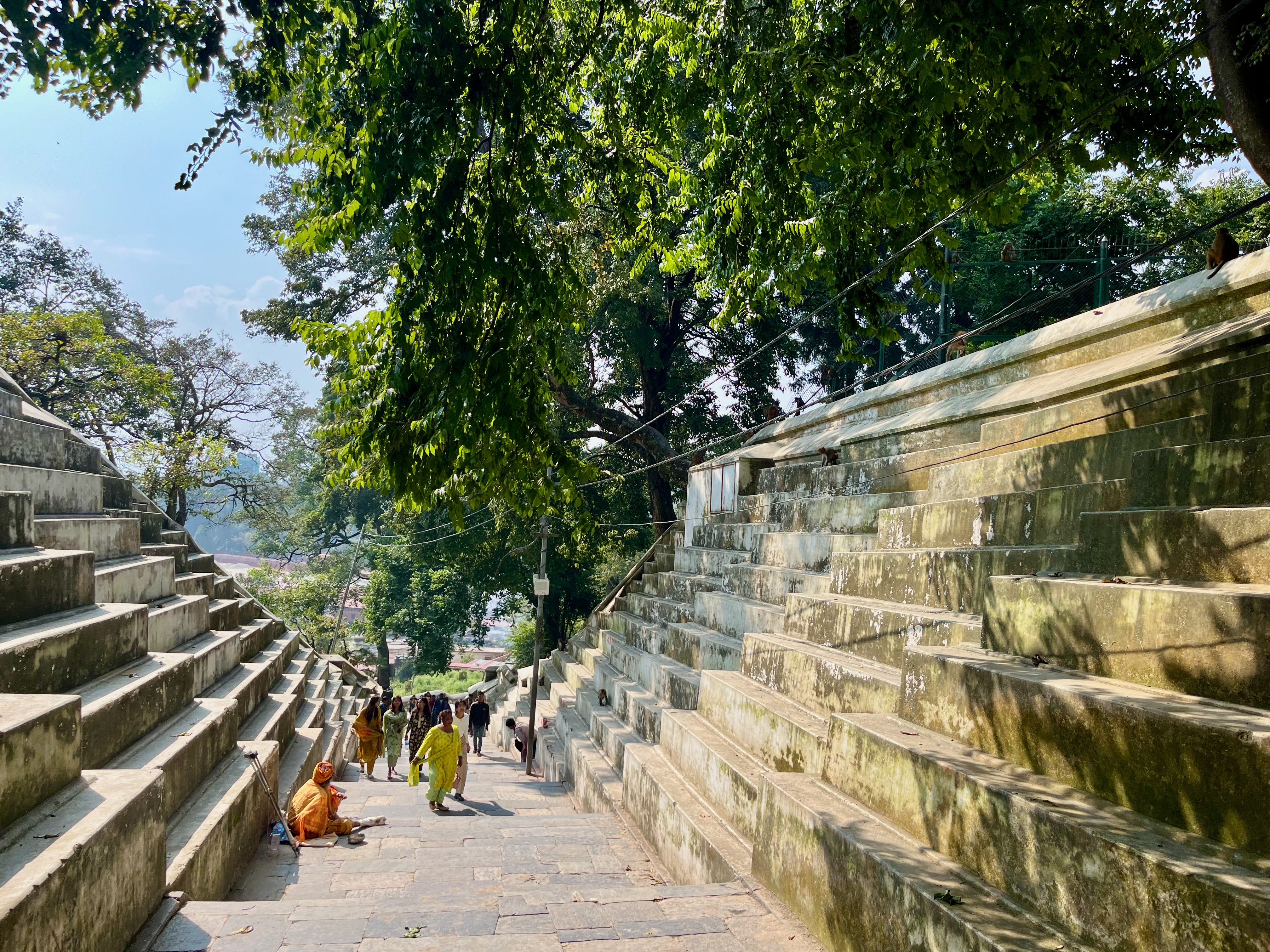
Next, we made our way to Pashupatinath Temple, a sacred site where it’s believed that visiting will purify one’s soul, body, and wealth. “May your footsteps always move forward toward the well-being of humanity,” a phrase written on the ticket.
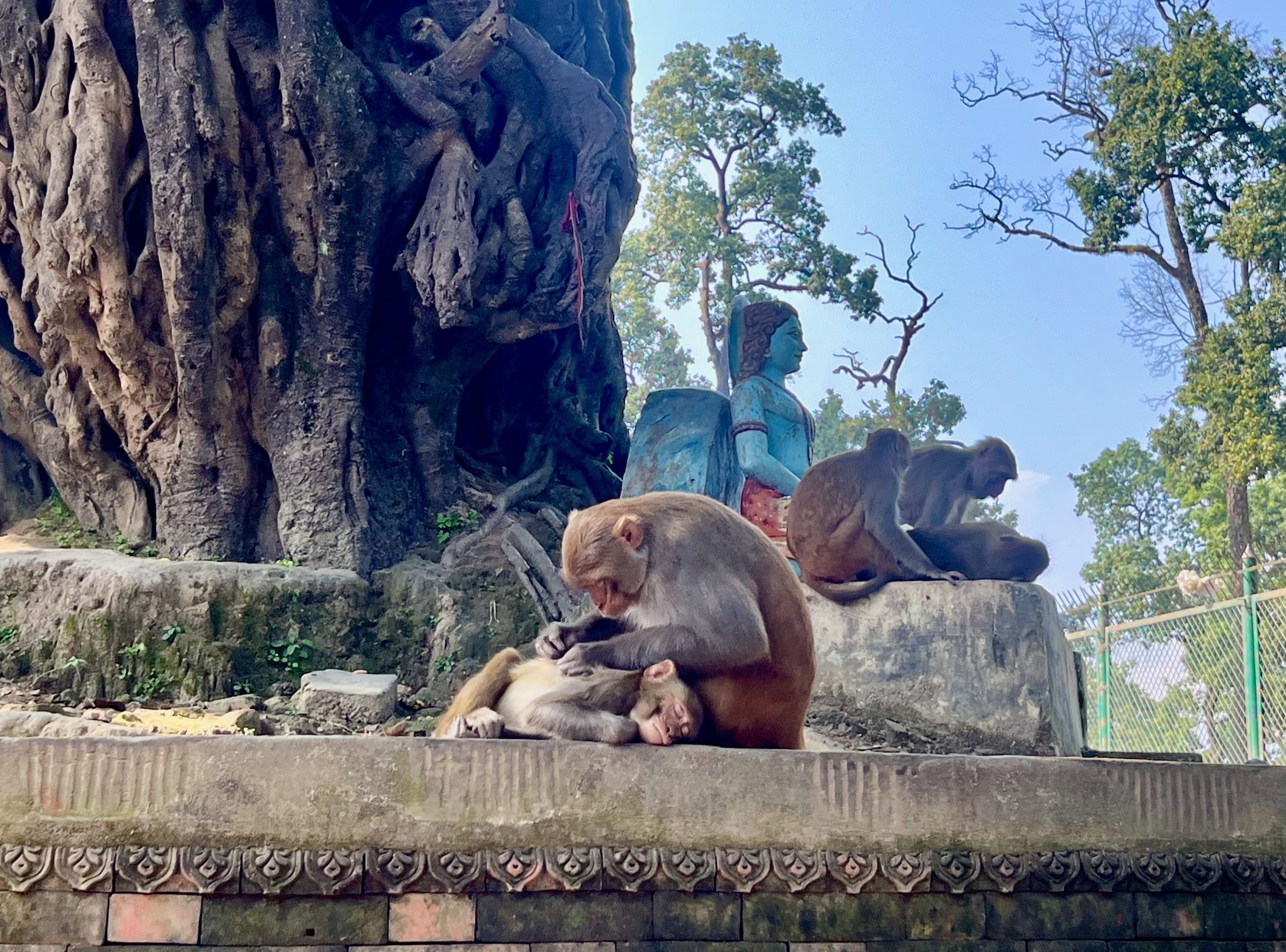
We walked along a stone path bordered by walls that rose like steps. Stone-carved sculptures of hippos lined the walls. I was pleasantly surprised to see monkeys, everywhere, and was advised not to approach them, as they can get aggressive. It’s also wise to keep food out of sight, as they’re skilled at snatching it.
As we finished our walk around the temple’s courtyard, following a sturdy stone path, Lovely invited me to tea at his home, something he said he had never done for someone he'd met on the street. He arranged a cab for us and guided me to a neighborhood about 30 minutes away.
Churidar (Traditional Clothing)
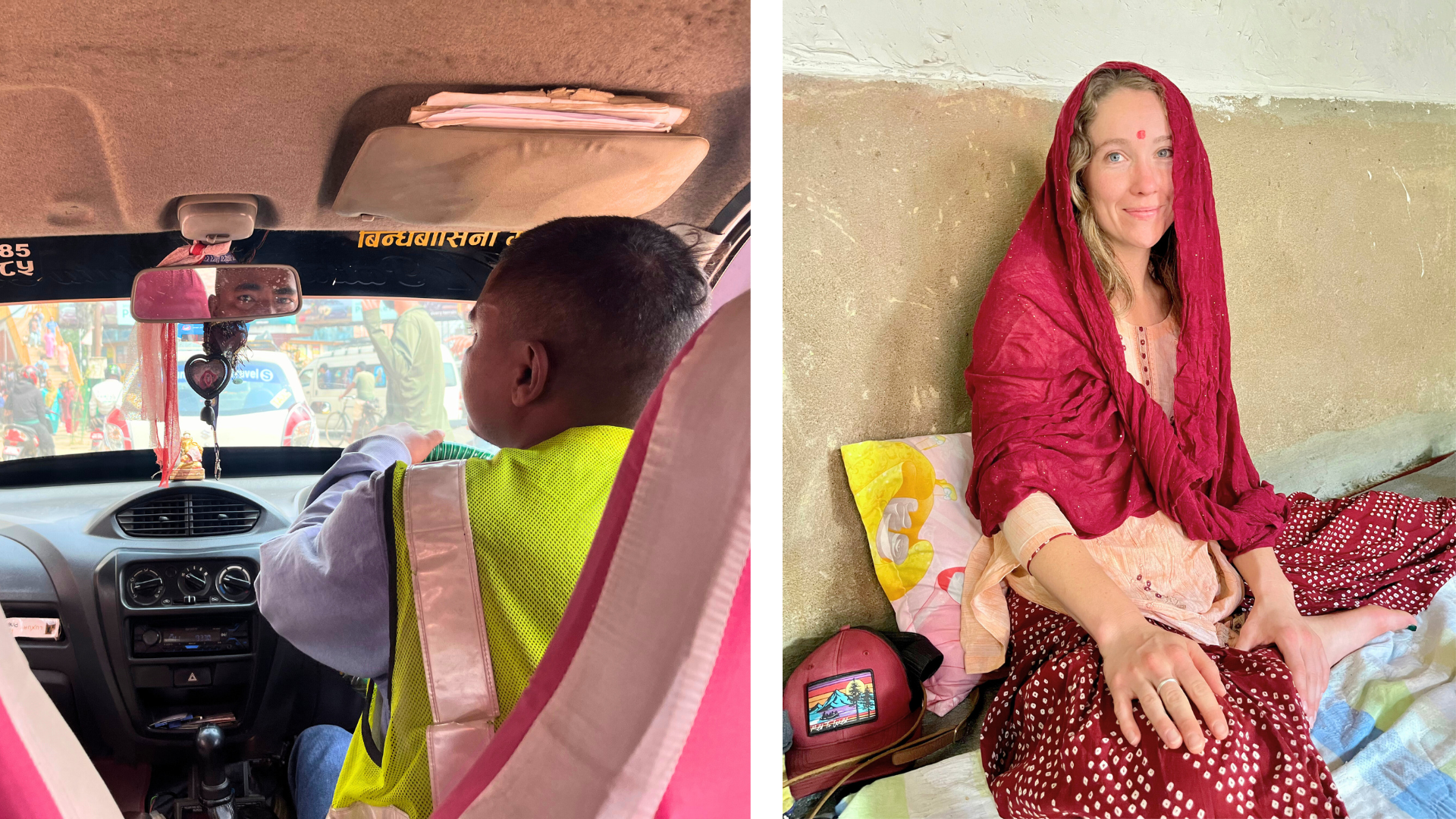
His house was nestled in a cluster of small, interconnected spaces, accessible only by a narrow path. The one-room dwellings were packed close together, with shared facilities like running water and bathrooms. Lovely led me to his space, but as his mother, Lovely informed me, was at the hospital helping a friend give birth, we went instead to his neighbor Savita’s home. She greeted us warmly and quickly set about boiling a pot of tea.
When we mentioned that I had purchased some of Lovely’s artwork, Savita smiled and offered to dress me in a churidar, a traditional Hindu outfit. I laughed, thinking it would just be for a short time, but after struggling to pull the tight cotton pants over my heels and the long shirt with fitted sleeves up to my elbows, Savita wrapped a scarf around my head, put bangles on my wrists, and informed me that I could keep the outfit.
Lovely then shared with me that he lived in one room with his mom, grandpa, and blind uncle. Their bamboo house was destroyed in the 2015 earthquake, forcing them to rent this place. They had also lost Lovely's father to COVID-19, and as a result, Lovely had become the primary provider for the household. He explained that, as an art student, it was often difficult to make ends meet, and they were currently two months behind on rent. He hesitated before mentioning that any help would mean a lot. I asked how much the rent was, and upon hearing it was $111, I offered to cover one month’s rent for them.
A week later, my mom reached out, asking for more paintings and expressing her willingness to pay for them. I took the opportunity to ask if she would also be willing to cover another month of Lovely's rent, and she kindly agreed. Together, we helped Lovely pay off the two months of rent he owed.
After thanking them for the tea and the truly wonderful day, and agreeing to stay in touch, I used the inDrive app to hail a motorcycle taxi. Soon, we were weaving through the streets of Kathmandu, the driver in control, and me, a white woman (gori) wrapped in a pashmina, clinging to his back as the old city blurred past.
Bhaktapur: “The City of Devotees”
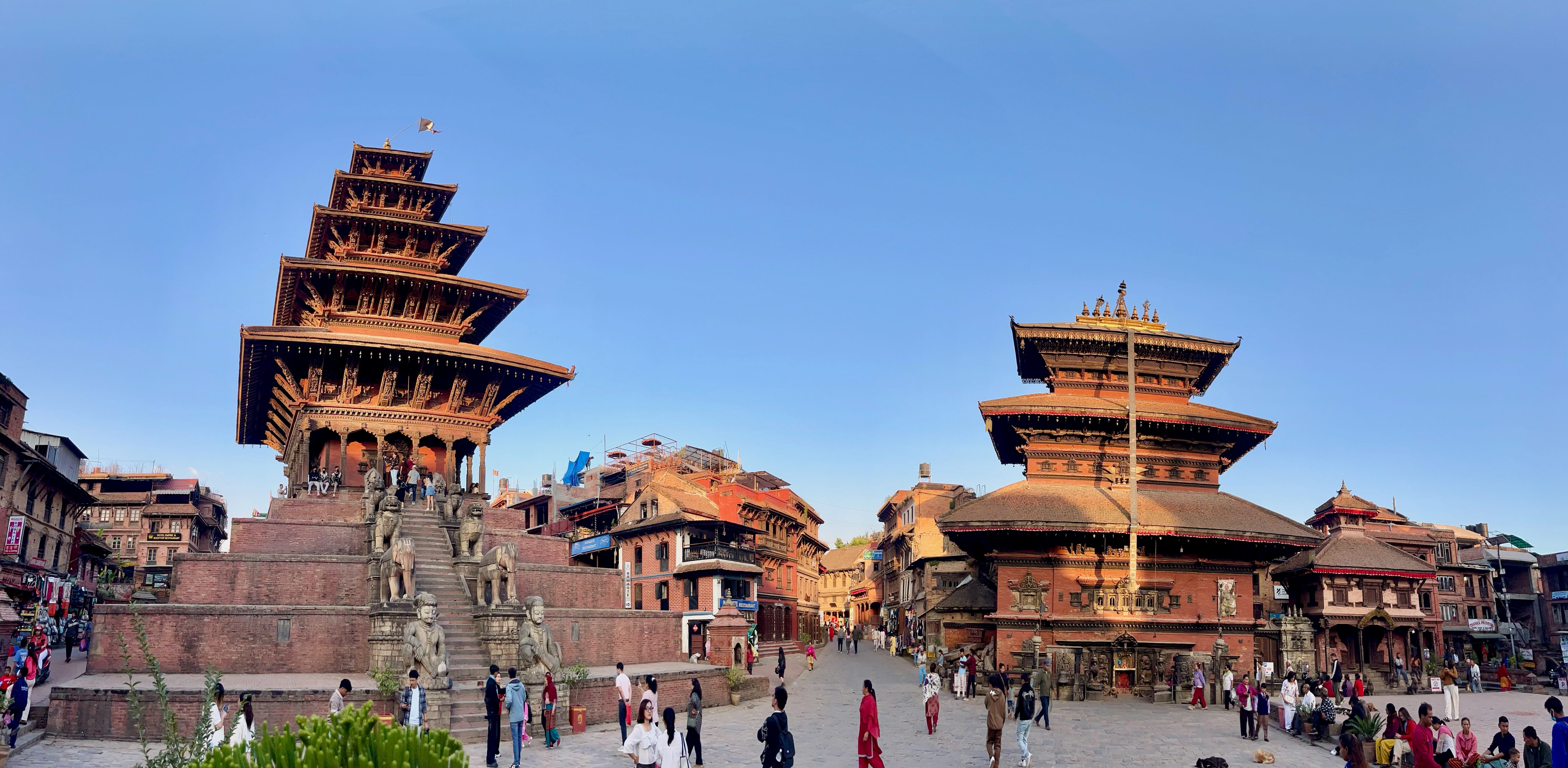
Born and raised in Kathmandu, Shyam, the owner of a popular, bohemian hostel in the Thamel District, became my zany adventure partner for a stroll through Bhaktapur, “The City of Devotees,” named for its numerous temples, the devotion of its people, and the historical decree of Prime Minister Juddha Shumsher Rana.
We boarded an evening bus heading east for just 300 rupees, a fraction of the 1,500-rupee fare for a taxi. The journey took about 45 minutes, but traffic was light.
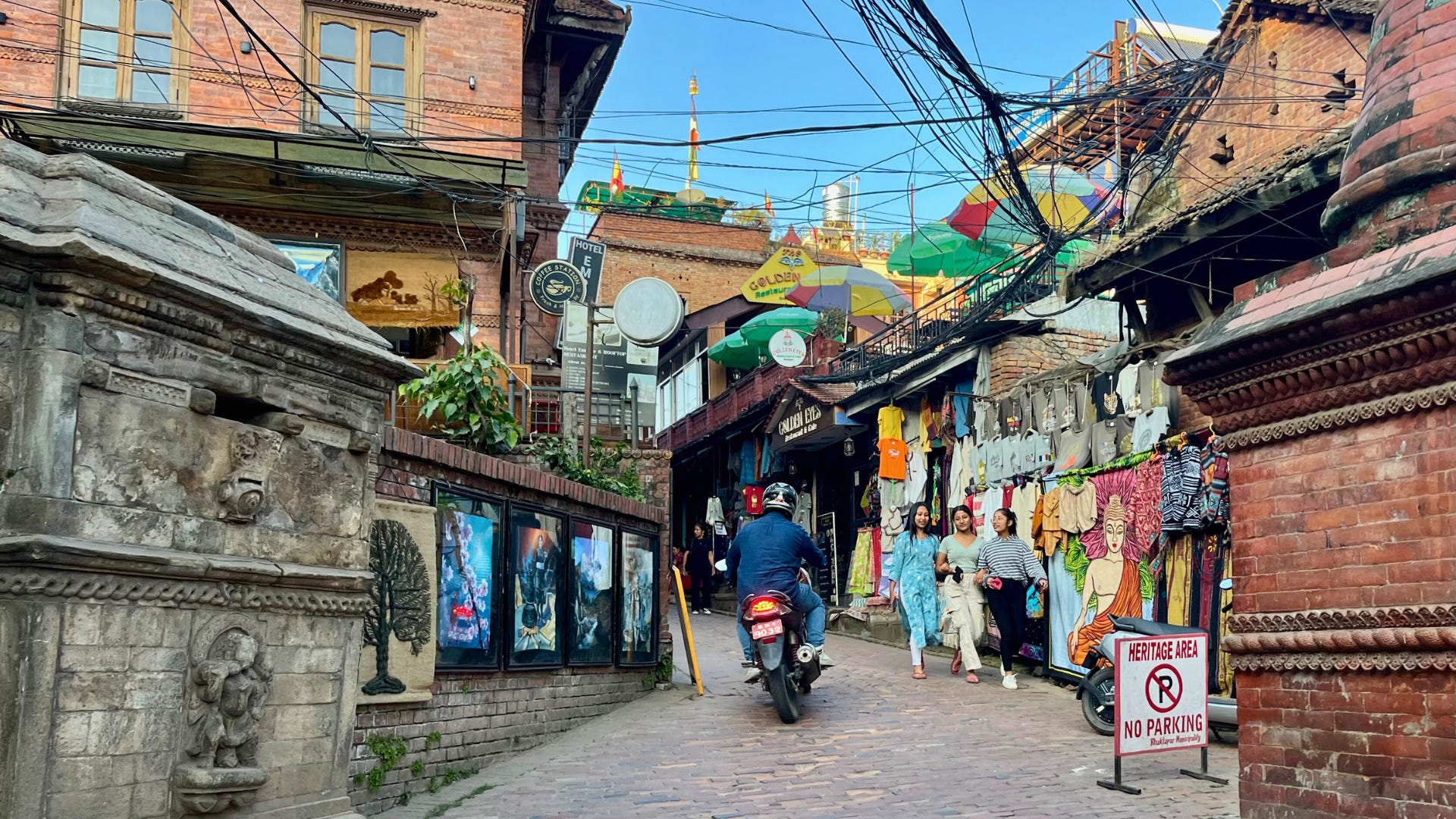
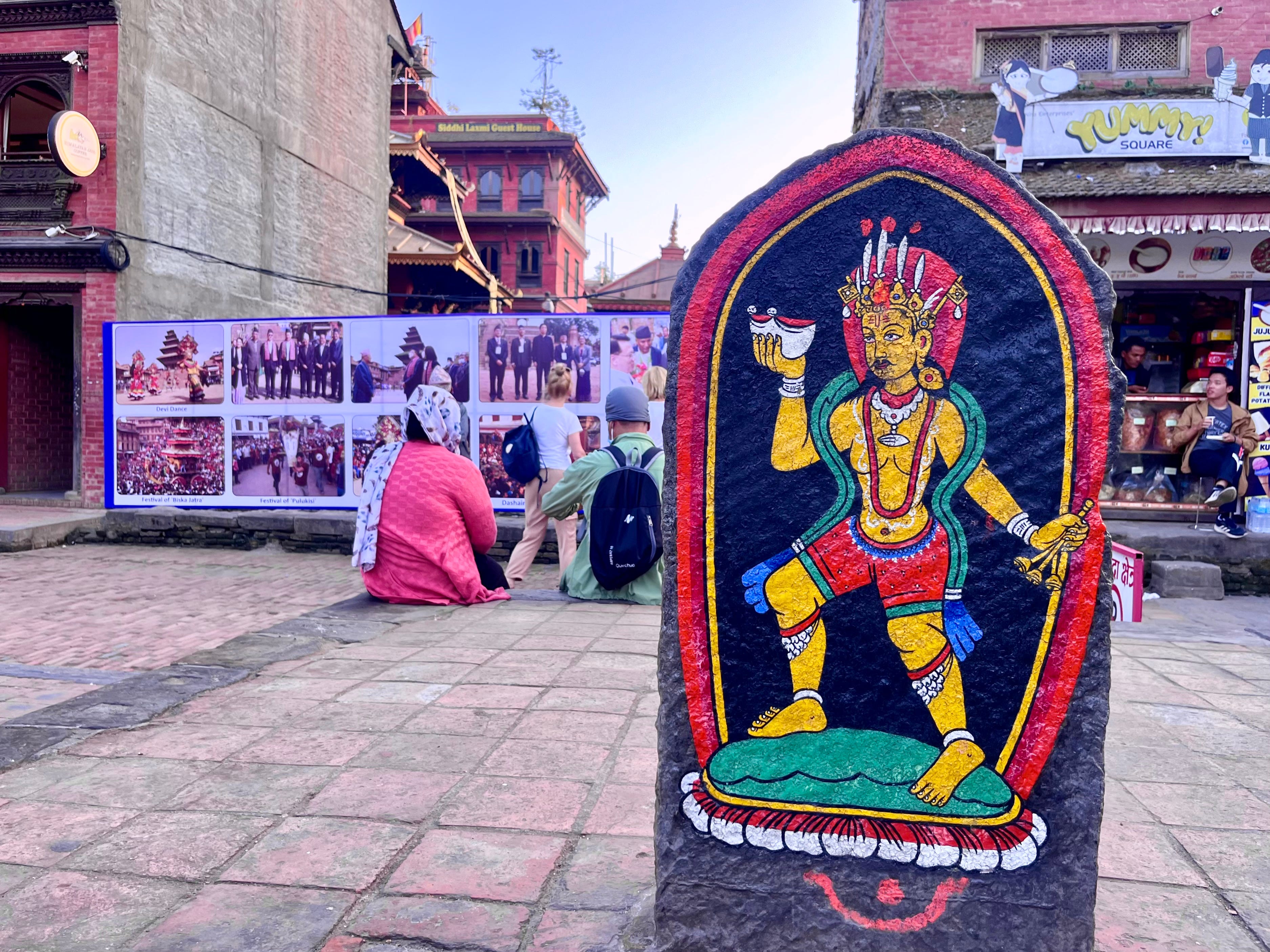
We got off the bus by a large, square pond in the middle of a square with smaller buildings than those from where we came in Kathmandu. Most city ponds like these are closed during certain hours of the day, which Shyam told me is meant to recharge its calming effect. Many human-made ponds were built to offer purity of space: places to walk around and destress, prey. It was mid-afternoon, and we began our culinary journey with a black coffee in a cafe. Owning a hostel where many Westerners frequent has converted Shyam into a coffee drinker. He drinks plenty of tea, too.
We sat and sipped our coffee, waking up from the bus ride.
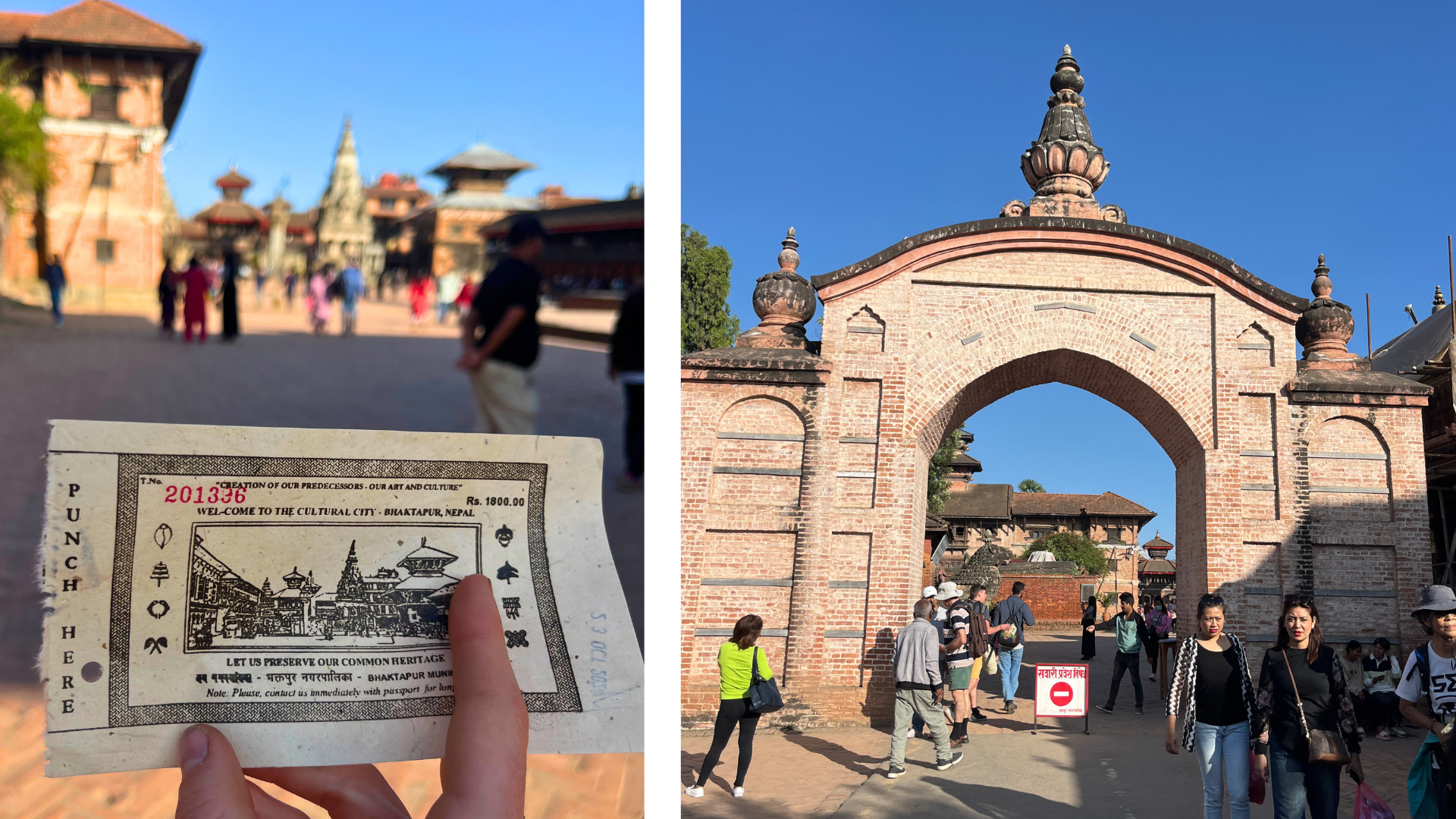
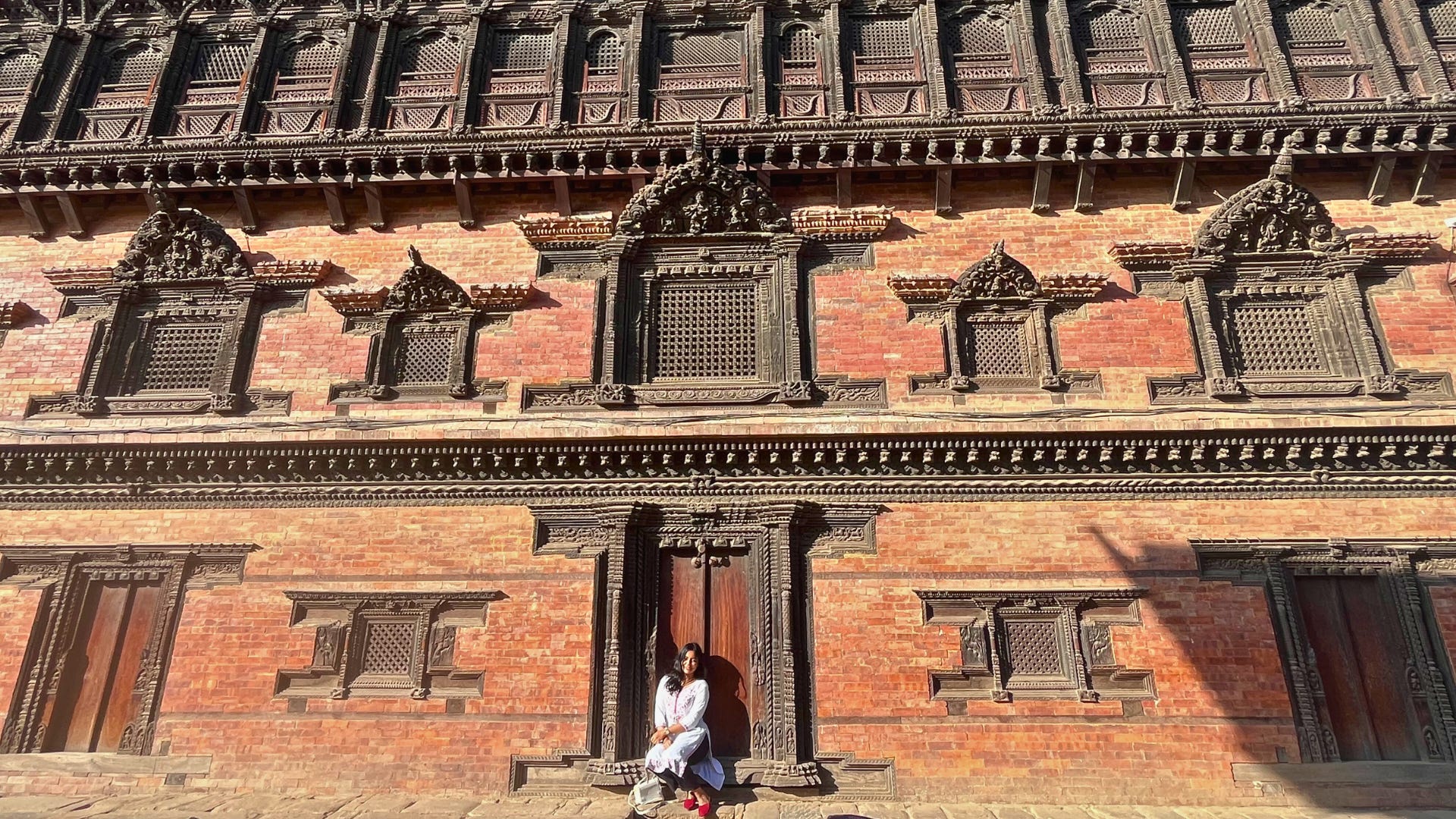
Once recharged, Shyam led me through an ornate brick archway to the ancient city of Bhaktapur, where we paid an entry fee. This Nepal trip was my first time in Asia, and here, I encountered temples of the like that lived in my imagination of what temples in Asia would be like. They loomed over ancient stones etched with the oldest written language, alongside sculptures of Buddhist deities in layers that folded towards the sky like wilting lilies. The rooftops curled upwards, and long metal ribbons descended down to the cobblestone.
Juju Dhau (Yogurt)
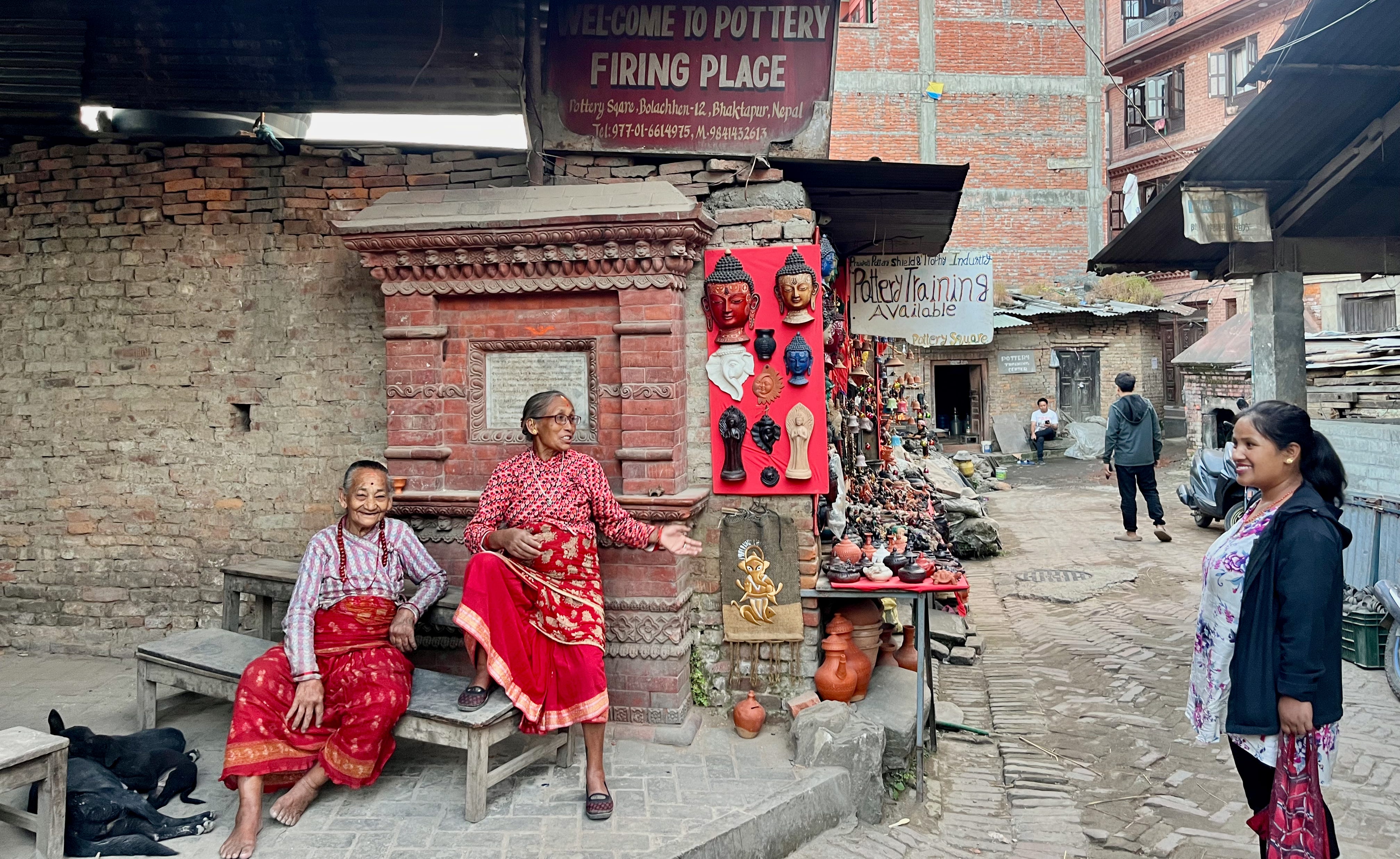
Shaym brought me to the ceramics sector, where potters wielded clay outside, stacking tons of ashtrays, pots, and cups with dimpled, curled, and folded edges. Wheel throwing classes were advertised right on the street. A couple of elderly women sat by a ceramics store, conversing and laughing with toothy grins.
We purchased yogurt served in clay cups you toss when you’re done as if they were paper. This is a famous food here in Bhaktapur, with many tourists arriving just to seek it out.
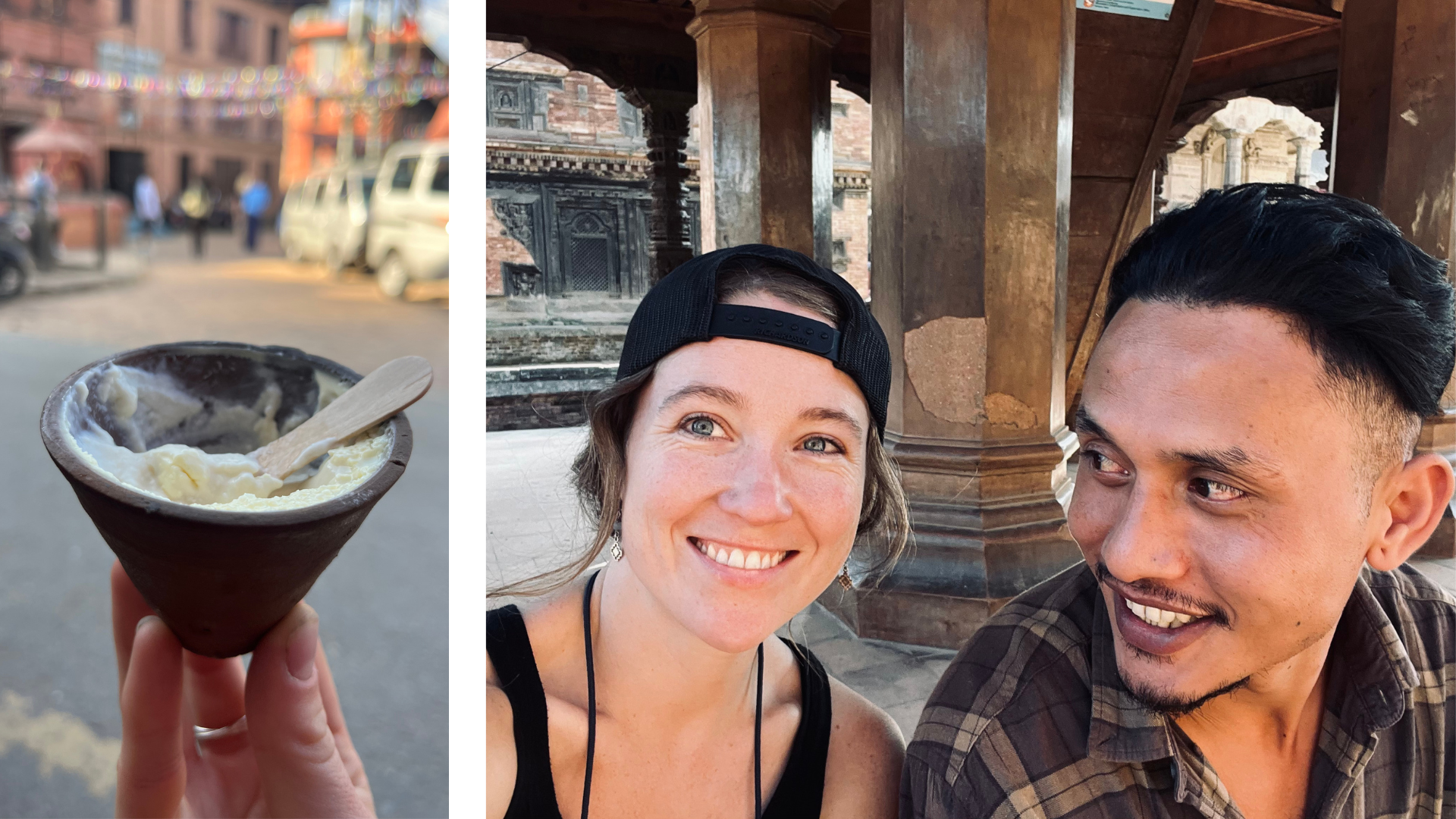
“I want to save my cup, it’s so well made.” I told Shyam.
“That’d be weird.” He responded.
I tossed it as casually as a paper cup.
Next, we entered a museum. The attendants told me I could pay 300 or 500 rupees to be able to take photos. I declined. Hindu-Buddhist artwork is breathtaking, often depicting the Buddha and his many escapades on his way to nirvana. There were kama sutra paintings, showing the flow of energy through the body and different points of power and passion.
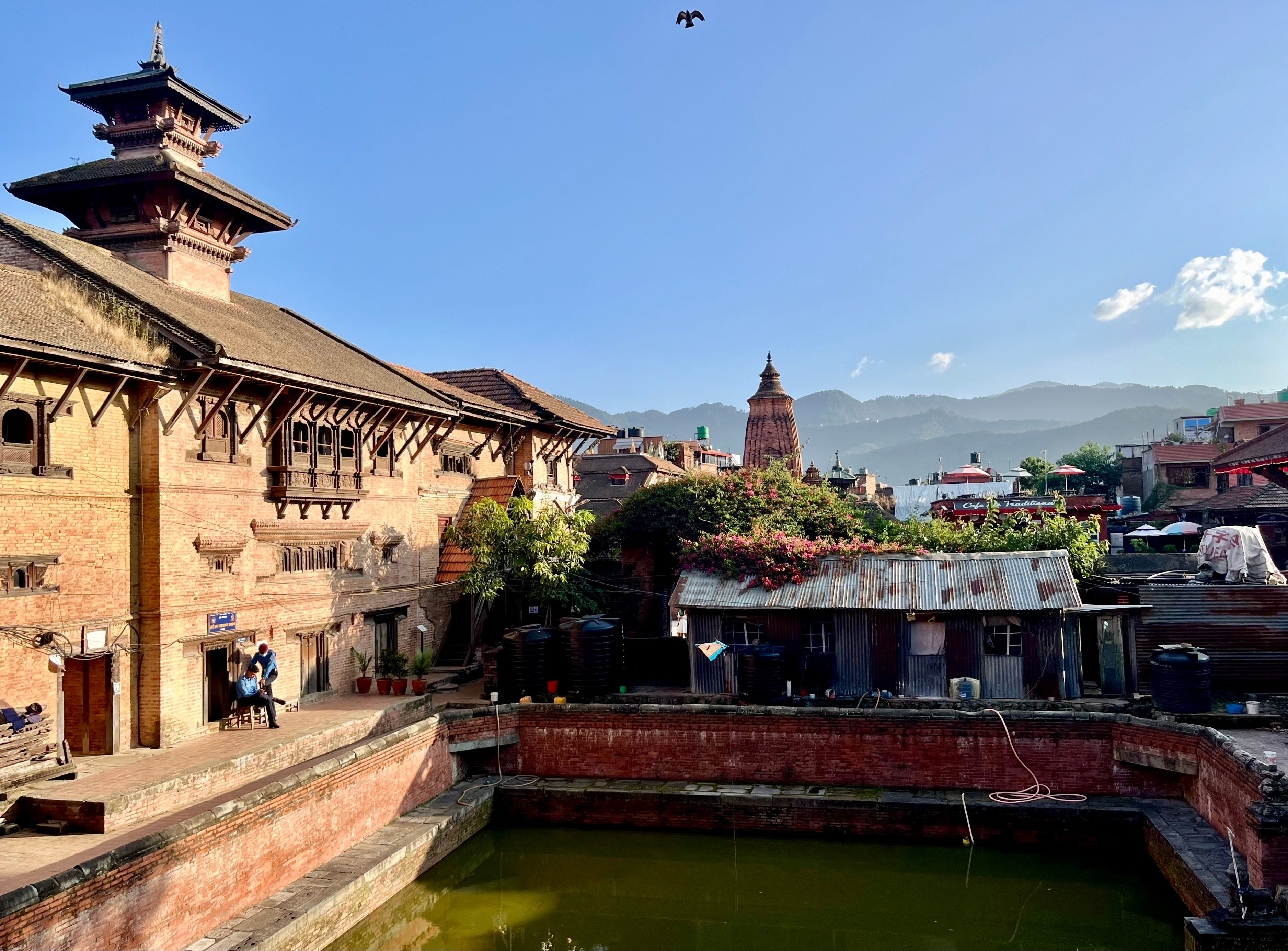
We walked through many halls, taking in all the incredibly detailed artwork and sculptures, and on the top floor, looked out over the courtyard with guards sitting by the pond. A bird flew over the walls of the temple.
Bara (Lentil Pancakes)
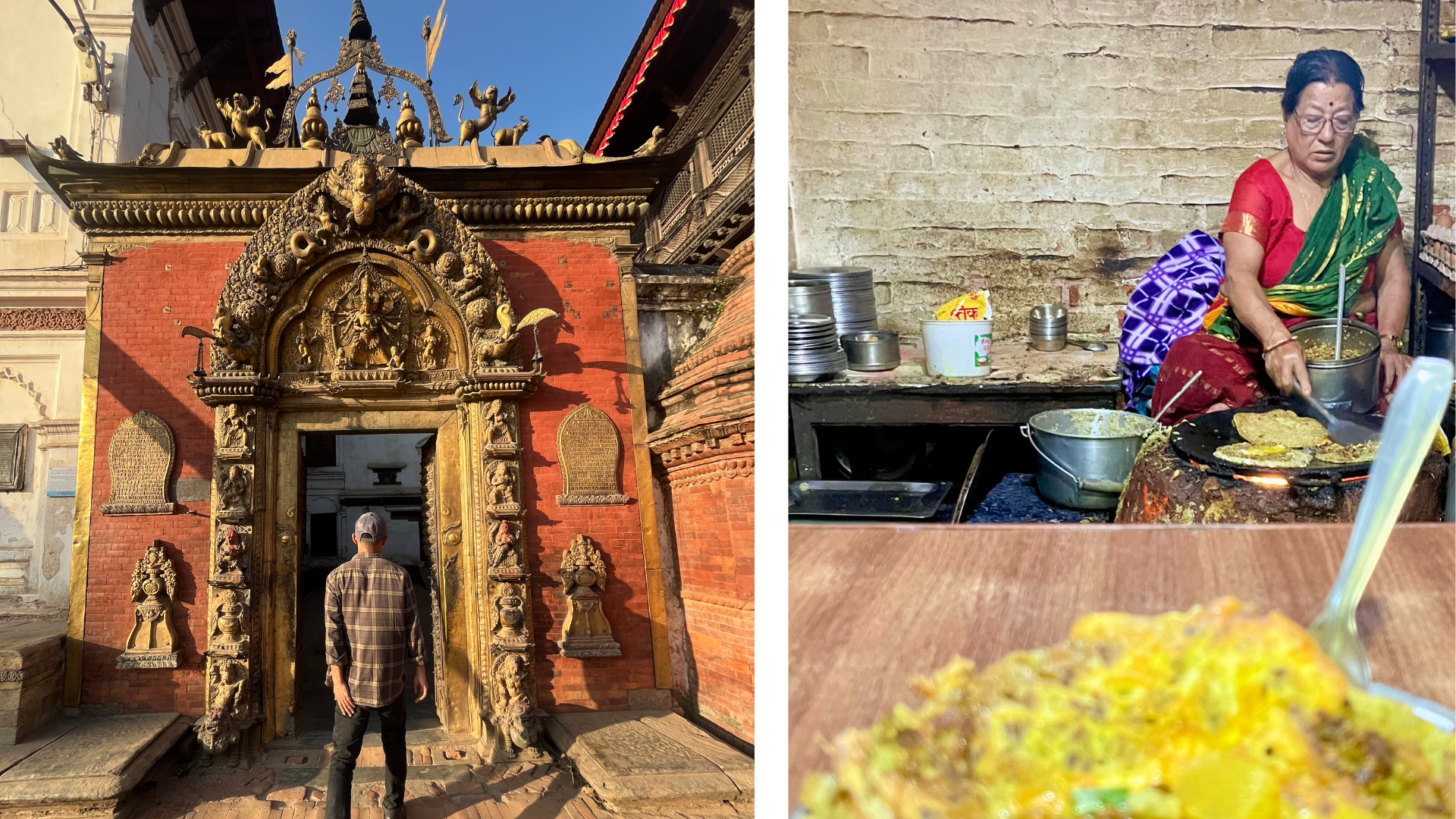
Leaving the building, we returned to sunlight and embarked on our third culinary adventure: Bara cooked by a famous woman who’s been cooking it for years. Shaym led me to her lair, and, ducking our heads to enter the small door, saw her sitting in a corner frying lentils, eggs, meat, and veggies into pancake-like patties on a fire hot pan. Newspaper articles depicting her fame hung, framed, across the brick walls.
We sat and smiled at her, saying hello. Her face beamed when she saw me. “You look just like my daughter. Wide faced and white. She’s studying abroad right now.” I was flattered by her outpour of love. We were served two plates with Bara, which was tasty and a hearty, nutritious meal I could eat for breakfast most days. Fat and happy, we said bye to the women, who had an incredible energy, the kind you see in people who are doing exactly what they want to be. Finding purpose.
Rice Wine
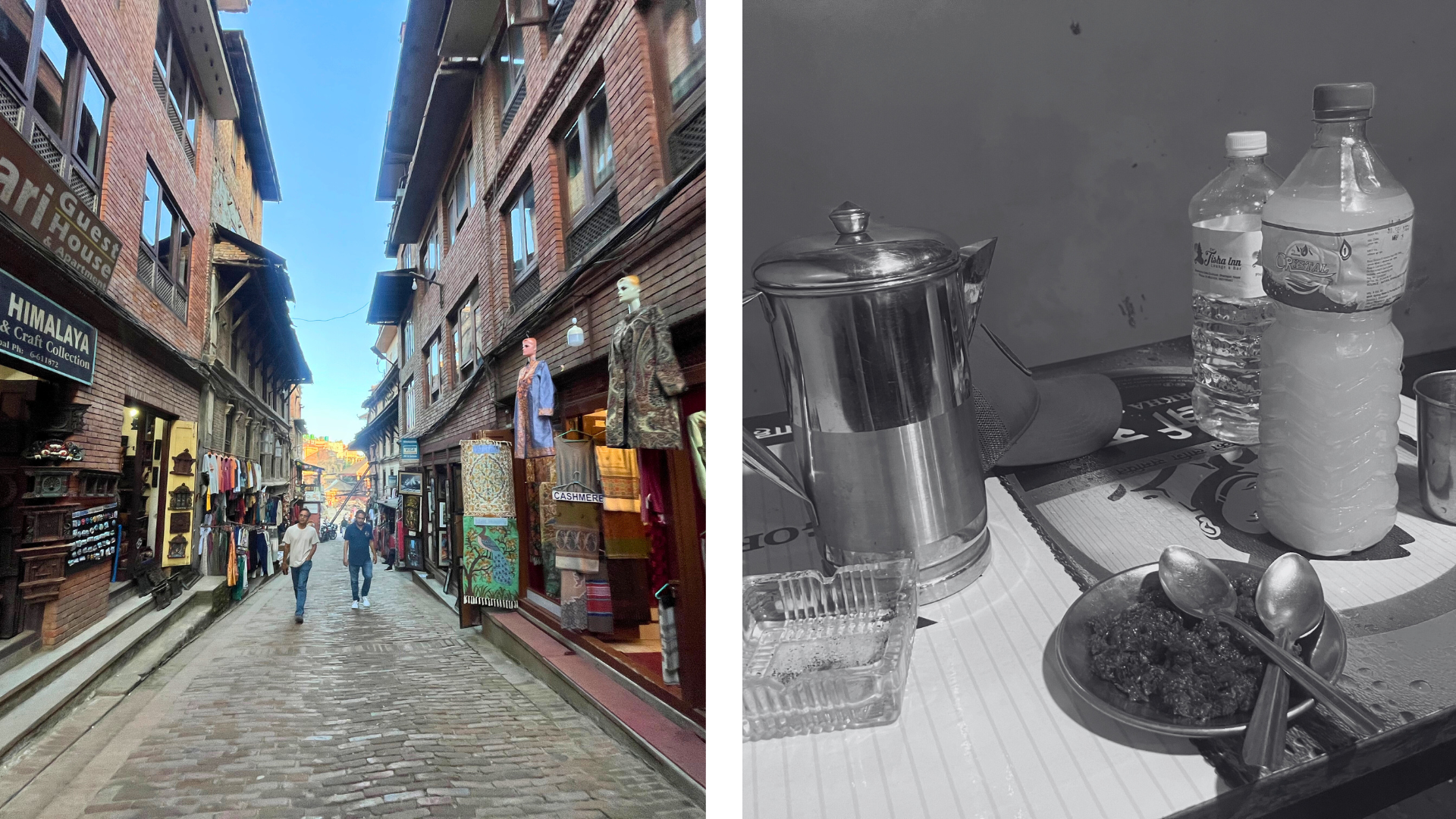
As the evening drew to a close, we saved the most alluring culinary adventure for last: rice wine. Shyam led me to another hole in the wall, where two men sat watching soccer on the TV. We ordered the wine, and they brought out a large plastic bottle full of it. We poured ourselves some glasses. It was a pleasantly sour, sweet, milky wine that I was told is actually more similar to beer and should taste sweeter. I enjoyed it nonetheless.
Shyam offered to order me some regional Newari food, which is an assortment of chicken, beef, and buffalo meat, either spicy or raw, and fermented vegetables, lentils, dumplings, edamame, and a neutral grain you eat in between the intense flavors. He’s Newar himself, a caste in Nepal credited for inventing some of the country's most vibrant food and cultural traditions. I was proud to have made a Newar friend.
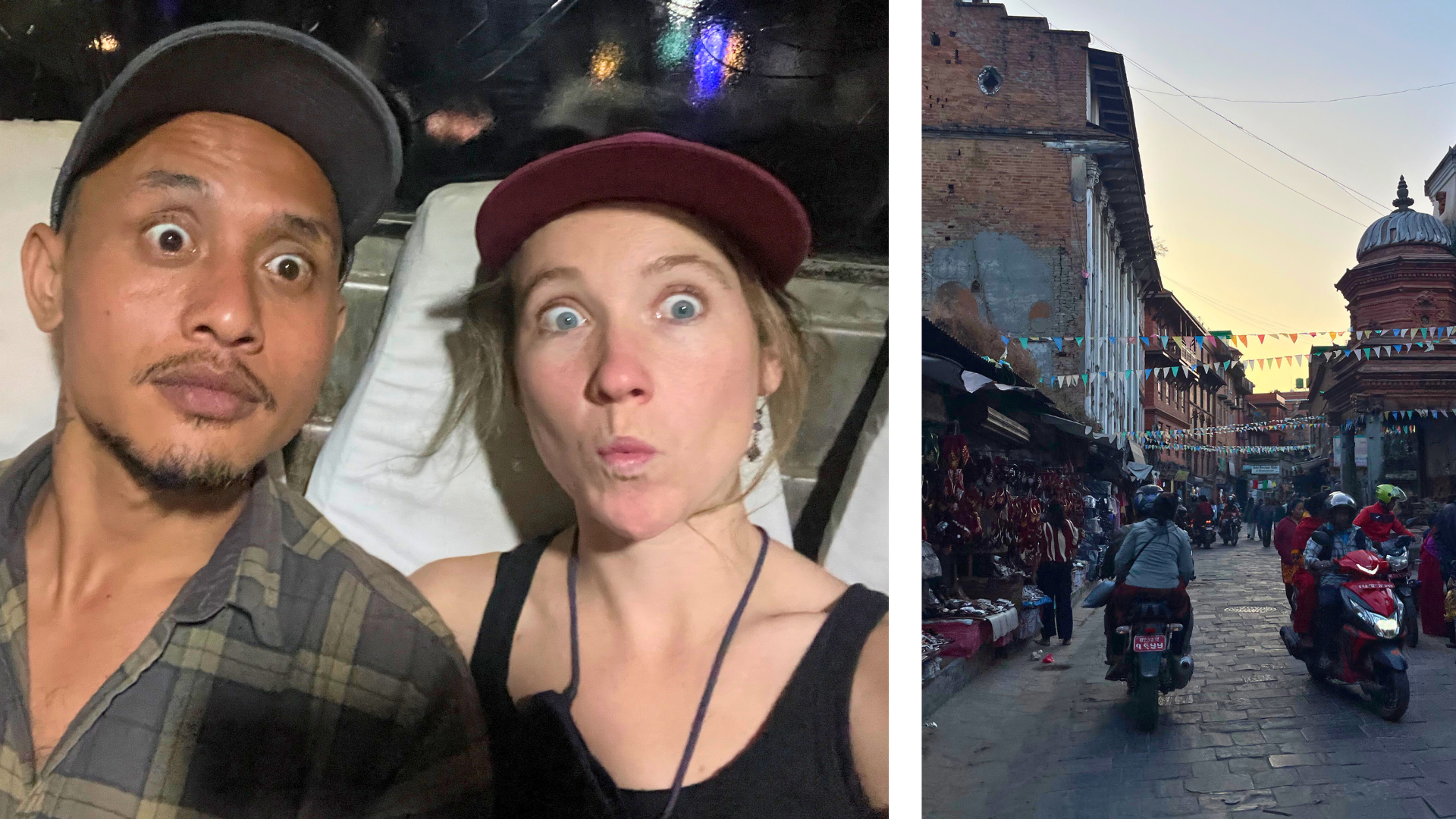
He ordered me some raw Newari meat, and I loved it. It tasted like sushi. We drank our wine, paid our tab, and wandered on the street once again. Night had fallen, and we caught a very crowded bus back to Kathmandu, reminiscing on how worthy of a trip it was, eating, watching potters spin clay, and taking photos, but not too many.
Wondered when there was going to be more. (I was looking for more flying dinner plates!🤣)
You are smazing!